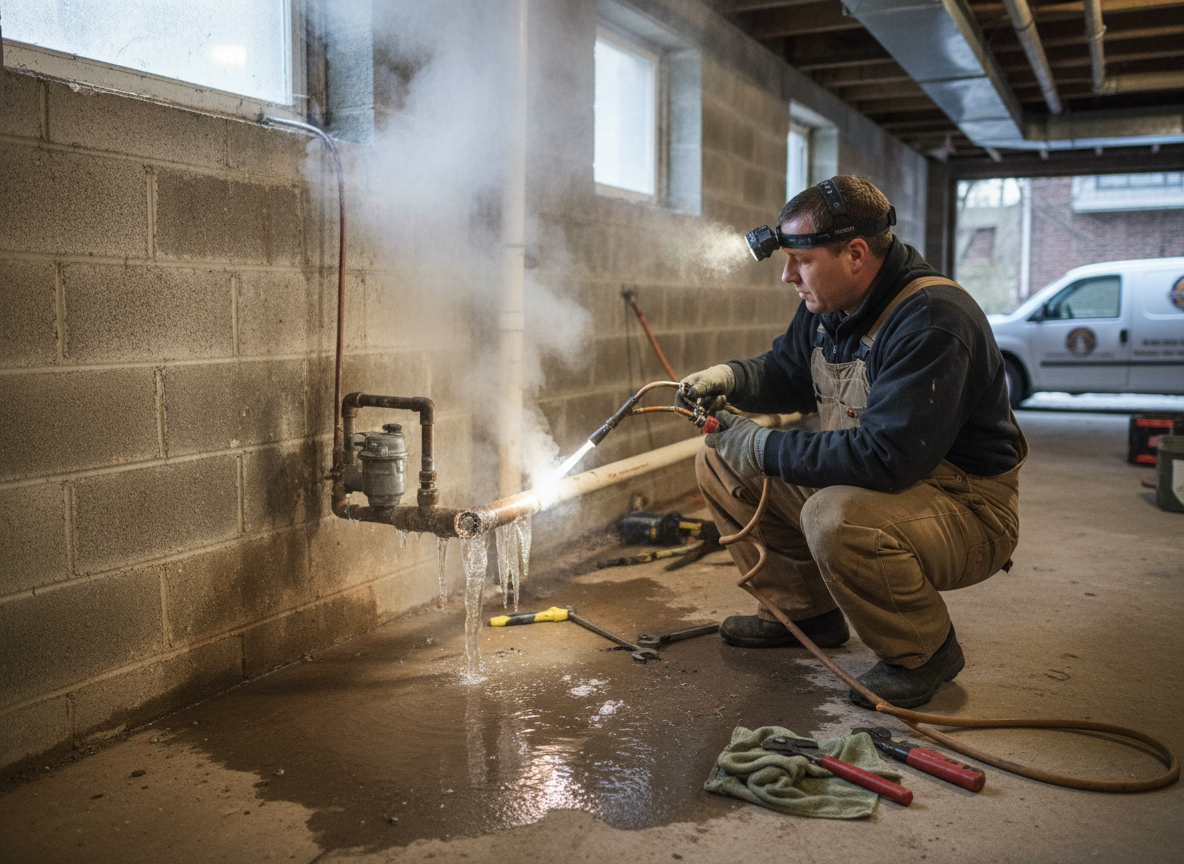
Atlanta sits in Montmorency County where humid continental winters routinely push temperatures well below freezing for weeks. Older single-story homes and cabins built before the 1980s often have supply lines running through unheated crawl spaces or along exterior walls with minimal insulation. When these lines freeze, expansion can split copper or older galvanized pipe, sending water into floors and insulation once the thaw arrives. Technicians check both the visible break and the full run because a second weak spot frequently appears within a few feet of the first.
PEX tubing has become common in Gaylord and Lewiston remodels, yet many Atlanta properties still rely on rigid copper or polybutylene that fails differently under ice pressure. Thawing must be done slowly with controlled heat or infrared to avoid steam bursts or joint separation. After water is shut off and the line is opened, moisture meters trace how far water traveled under subfloors, especially in the sandy soils common near the Pigeon River. Skipping this step leaves hidden saturation that later grows mold during the warm summer months.
Access challenges appear quickly in winter. Snow depth on driveways and roofs can block exterior hose bibs or force interior wall cuts that homeowners later want hidden. Repairs follow current Michigan plumbing code for material transitions and shut-off valve placement so future freezes are easier to isolate. Every job ends with a pressure test and documentation of the repaired section for insurance purposes.
Technician insight
In Atlanta the thing that catches most people out with Frozen Pipe Repair is how many mid-century homes still have supply lines running just under the floor joists with only a thin layer of insulation, so a single night below zero in Montmorency County can split pipe in two places at once.
Frozen line under kitchen floor near Lewiston Road
A homeowner in Atlanta noticed reduced water flow after a week of sub-zero nights. Inspection found two splits in the original galvanized line running under the kitchen. The section was replaced with PEX, the subfloor dried, and shut-off valves added at the main and under the sink so future freezes can be isolated without shutting down the whole house.
Frozen Pipe Repair Services We Offer
✓Emergency Pipe Thawing
Controlled thawing of supply and drain lines using infrared and heat tape to prevent steam damage in Atlanta homes during extended cold spells.
✓Burst Pipe Replacement
Sectional replacement of split copper or galvanized lines with code-approved PEX or copper, including wall or floor restoration after the leak is isolated.
✓Pipe Insulation Installation
Adding closed-cell foam or heat tape to vulnerable runs in crawl spaces and exterior walls common in pre-1980s Montmorency County housing.
✓Slab Leak Location
Non-invasive detection of leaks under concrete slabs caused by frozen lines, followed by targeted repair access points to limit floor damage.
✓Post-Thaw Water Extraction
Removal of standing water and moisture from floors and insulation after a frozen pipe releases, preventing secondary mold growth in Lewiston-area cabins.
✓Winterization Inspection
Full walkthrough of exposed plumbing before first hard freeze, identifying at-risk lines near unheated garages and attics in Atlanta neighborhoods.
Frozen Pipe Repair Cost in Atlanta, MI
| Service | Typical Range | What Affects It |
|---|---|---|
| Initial frozen pipe inspection | $125–$225 | Covers travel within Montmorency County and basic moisture mapping |
| Thawing and minor repair | $350–$650 | Single accessible line; increases with wall cuts or multiple freezes |
| Sectional pipe replacement | $450–$950 | Includes new valves and pressure test; higher for slab access |
| Post-thaw drying package | $300–$700 | Equipment and monitoring time; varies with saturation depth |
Ranges are typical for Atlanta, MI and confirmed with an exact written quote before any work starts.
How it works
- 1
Site Assessment
Technician locates the freeze point, checks for multiple weak spots, and maps water migration through floors in the specific Atlanta property.
- 2
Water Shutoff and Thaw
Main valve is closed, then controlled heat is applied until flow returns without creating additional pressure damage.
- 3
Repair or Replacement
Damaged section is cut out and replaced, with new shut-off valves added where access allows for future winter isolation.
- 4
Drying and Moisture Check
Affected materials are dried with equipment suited to the home's construction, followed by final moisture readings.
- 5
Prevention Review
Homeowner receives a written list of insulation upgrades and shut-off locations tailored to the Montmorency County climate.
Pricing
Upfront quotes after inspection; price depends on pipe access, number of affected runs, and whether wall or floor restoration is required.